What Georges Chahwan Gets About Marketing That Most People Miss

Most marketers are chasing the next big campaign. They optimize for this quarter, celebrate a spike in traffic, and move on. But Georges Chahwan has never operated that way.
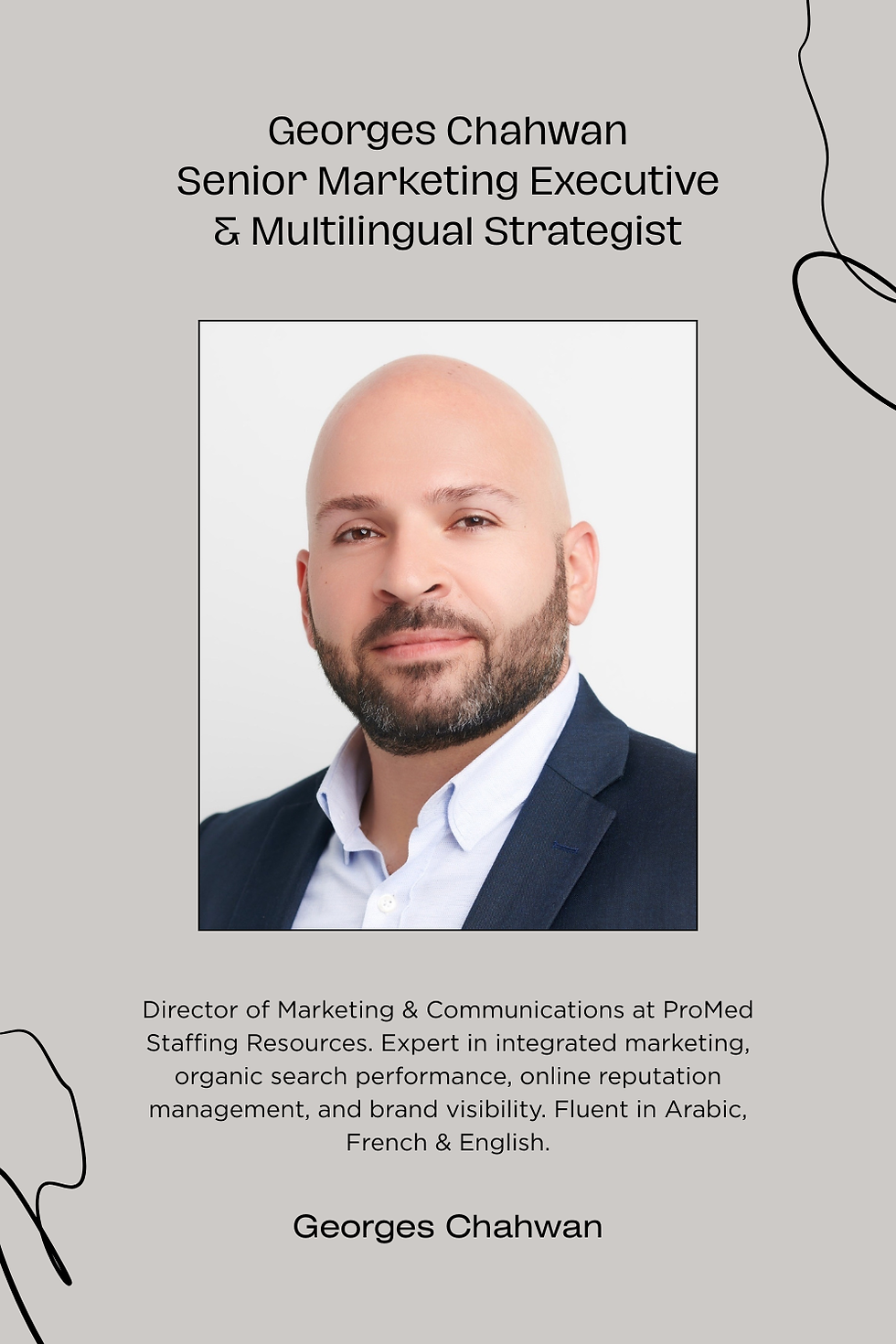
As Director of Marketing and Communications at ProMed Staffing Resources, Georges Chahwan has spent years doing something most marketing teams never attempt — building an integrated marketing infrastructure designed for compounding, long-term returns.
So what makes his approach different? And why does it consistently work when so many campaigns fizzle out after launch? Here's an honest look at the principles behind his strategy — and what most marketers are still missing.
He Thinks in Systems, not campaigns.
Most marketing teams think in campaigns. Launch a campaign, measure it, archive it, repeat. Georges Chahwan thinks in systems.

There's a massive difference. A campaign has a start date and an end date. A system keeps running. It earns organic search rankings that don't evaporate when the ad budget runs out. It builds reputation scores that climb over months, not days. It creates audience trust that a single campaign simply cannot buy.
Why This Matters for SEO
Search engines reward consistency. A brand that publishes quality content regularly, earns backlinks organically, and maintains a strong technical foundation will always outperform a brand that bursts onto Google with a big push and then goes quiet. Georges Chahwan's system-first mindset naturally aligns with how search algorithms actually work — which is exactly why his organic rankings hold and improve over time.
Multilingual Marketing Is Not a Feature — It's a Core Strategy
Here's something most marketing directors would never attempt: running native campaigns simultaneously in Arabic, French, and English.
Not translated campaigns. Not content that was written in English and then repurposed. Campaigns are built natively in each language—meaning the messaging, tone, and cultural nuance are crafted specifically for each audience from the ground up.
The Competitive Advantage This Creates
Think about what this unlocks. Most brands reach one audience fluently. Georges Chahwan reaches three — each with messaging that actually resonates because it speaks to them in their own language, not a corporate approximation of it. In the staffing and healthcare space, where trust and clarity are essential, multilingual fluency is not just a nice-to-have. It is a distinct competitive edge.
His academic foundation in media and communication sciences gave him the framework to understand how language shapes perception. His fluency made him capable of executing it without filters.
Data Is Not Optional—It's the Whole Game
There's a version of marketing that runs on gut instinct and creative flair. It produces great-looking content that occasionally goes viral and usually fails to move the needle in any measurable way.
Georges Chahwan doesn't operate that way. Every initiative is data-informed. This means that evidence, not opinion, drives decisions about channel selection, content format, publishing frequency, and campaign targeting.
What Data-Informed" Actually Looks Like in Practice
Consider this: many marketing teams check analytics after a campaign ends. A data-informed approach uses analytics before a campaign launches to determine whether it should launch at all — and in what form. It uses ongoing performance signals to adjust in real time. Additionally, it calibrates the next initiative using outcome data.
This is why his work delivers compounding returns. Each initiative informs the next. Over time, the decisions get sharper, the targeting gets tighter, and the results get better. It's a loop that most marketing departments never build because it requires patience — something in short supply when teams are chasing quarterly metrics.
Reputation Is a Marketing Asset — And Most Brands Ignore It
Ask most marketers to define their key performance indicators and you will hear about traffic, leads, conversions, and cost per acquisition. Rarely will you hear the words "online reputation score."
Georges Chahwan tracks it. He treats reputation not as a PR concern but as a core marketing metric — because in the healthcare staffing sector, reputation is often what determines whether a candidate chooses your company or your competitor's. It is what determines whether a healthcare facility trusts you to deliver.
Reputation and SEO Are More Connected Than Most People Think
Google's quality guidelines increasingly factor in E-E-A-T signals — Experience, Expertise, Authoritativeness, and Trustworthiness. Brands with strong reputations, consistent positive mentions, and authority content naturally rank better over time. By focusing on reputation as a marketing output, Georges Chahwan is simultaneously building an SEO asset. Most brands don't realize these two goals are the same goal.
The Long Game Is Not Patience — It's Precision
It would be easy to describe Georges Chahwan's approach as patient. But patience implies waiting. What he practices is something more intentional — precision.
He makes every piece of content, every campaign, and every channel decision with a long-term objective in mind. Not "what will perform well this week" but "what will build something valuable six months from now." That distinction changes everything about how you allocate resources, create content, and measure success.
Why Most Marketing Teams Can't Do This
The harsh reality is that the majority of marketing teams are inherently incapable of pursuing long-term strategies. They're evaluated on short-term metrics, pressured for immediate results, and rewarded for visible activity rather than durable impact. This creates a cycle of reactive marketing — always chasing the next spike rather than building consistent growth.
What Georges Chahwan brings is the rare ability to hold both timeframes simultaneously — deliver results in the present while building infrastructure that pays off in the future. That's not common. And it doesn't happen by accident.
Final Thoughts
Marketing is full of people who know the tactics. Fewer people understand the strategy. And fewer still can connect both to sustained, measurable results.
Georges Chahwan represents a different kind of marketing leader — one who builds systems instead of campaigns, leverages language as a genuine competitive asset, and treats data and reputation as the twin foundations of everything he does.
Here's what you can take from his approach:
Think in systems, not campaigns — build infrastructure that compounds over time
Speak your audience's language natively, not through translation
Let data lead every decision, not validate it after the fact
Track reputation as an active marketing metric, not an afterthought
Optimize for long-term impact while delivering short-term results
The question worth asking isn't just what your next campaign will look like. It's what your marketing will have built six months from now — and whether you'll still be proud of it.
Georges Chahwan already knows his answer.


Comments